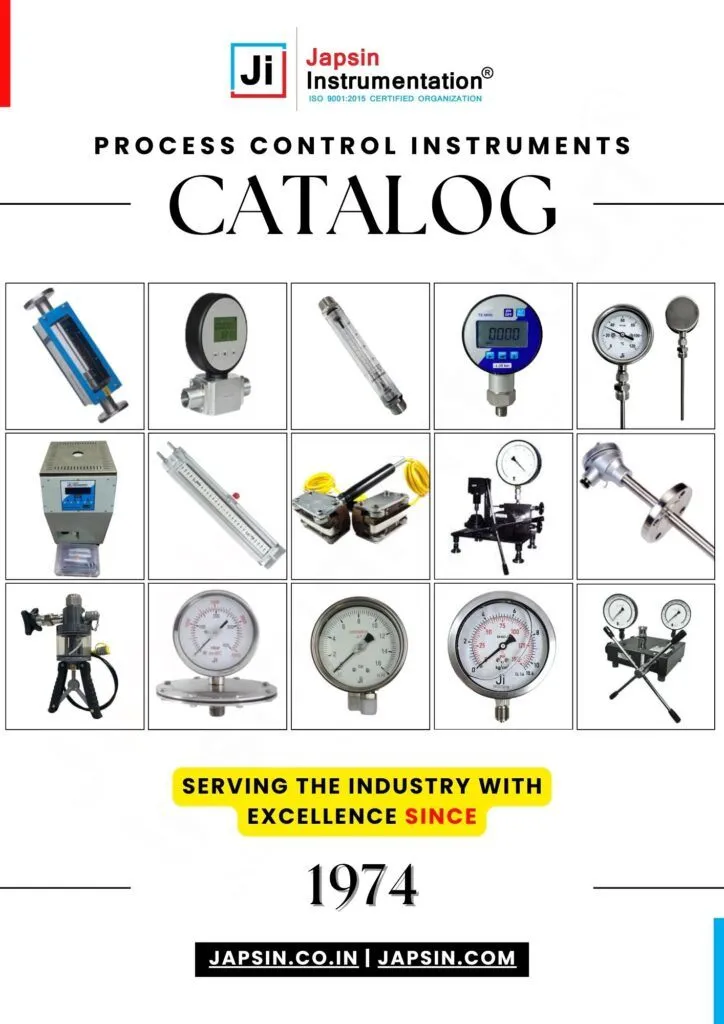


In industrial environments, accurate pressure measurement is critical to ensuring smooth operations, safety, and compliance with regulatory standards. Whether it’s chemical processing, oil & gas, power generation, HVAC, or pharmaceuticals, understanding how pressure behaves within a system determines the efficiency and safety of the process. Among the many instruments available for measuring pressure, the manometers has stood the test of time for its simplicity, reliability, and precision.
This blog will explore in detail the role of manometers in industrial process control, covering their working principle, types, benefits, applications, and best practices for use. We will also highlight why choosing a trusted manometers manufacturer and supplier in India, like Japsin Instrumentation, can help industries maintain optimal performance and safety.
Table of Contents
What is a Manometer?
A manometer is a device used to measure pressure in fluids (liquids or gases). Unlike electronic gauges or digital sensors, manometers rely on the principle of fluid displacement to provide direct, visual readings of pressure. They are often used where high accuracy and clarity are required and remain widely applied despite the availability of modern alternatives.
At its core, the manometer works by comparing the pressure of a process fluid to a known reference, often atmospheric pressure or a vacuum. The displacement of liquid inside the manometers column directly represents the pressure level.
Manometers are particularly favored in process industries for:
- Low-pressure measurement where traditional gauges may not be effective.
- Calibration standards, thanks to their reliability.
- Applications requiring direct, visual pressure indication without complex electronics.
Working Principle of a Manometer
The fundamental working principle of a manometers is based on hydrostatic equilibrium.
When a liquid (commonly mercury, water, or oil) is placed in a U-shaped tube and subjected to pressure on one or both sides:
- The fluid column will shift depending on the pressure difference.
- The height difference (Δh) between the two liquid columns correlates directly to the pressure applied.
The relationship is given by the equation:
P = ρ × g × h
Where:
- P = Pressure
- ρ = Density of the liquid
- g = Acceleration due to gravity
- h = Height difference of the fluid column
By using different liquids and scaling systems, manometers can measure a wide range of pressures, from very low vacuum conditions to higher industrial pressures.
Types of Manometers
Manometers come in various designs, each serving specific industrial requirements. Let’s look at the most common types:
1. U-Tube Manometer
- The simplest and most common type.
- Consists of a transparent U-shaped tube partially filled with liquid.
- One end is connected to the pressure source, and the other may be open to the atmosphere or another pressure source.
- Applications: Laboratory experiments, calibration, low-pressure measurements.
2. Inclined Manometer
- Features an inclined tube for higher sensitivity and accuracy in low-pressure ranges.
- Provides finer resolution of pressure differences due to its longer scale.
- Applications: Airflow measurement in HVAC, ventilation studies, and gas distribution systems.
3. Differential Manometer
- Measures the difference between two pressures.
- Commonly used to measure pressure drops across filters, orifices, and flow systems.
- Applications: Flow measurement in pipelines, filtration monitoring, industrial process optimization.
4. Digital Manometers
- Modern versions that combine the principle of manometers with electronic sensing.
- Provide digital readings while maintaining high accuracy.
- Applications: Field service, industrial automation, mobile calibration setups.
5. Well-Type Manometer
- Consists of a single reservoir (well) connected to a vertical column.
- Pressure changes displace liquid from the well into the tube.
- Applications: Gas pressure measurement in HVAC and low-pressure processes.
6. Micromanometer
- Highly sensitive instruments designed for extremely small pressure differences.
- Used in laboratories and research.
Industrial Applications of Manometers
Manometers are not limited to laboratories; they play an active role across multiple industries. Here are some key applications:
1. Chemical and Petrochemical Industries
- Monitoring gas pressure in reactors.
- Measuring low-pressure flows in chemical pipelines.
- Ensuring pressure levels during hazardous chemical storage.
2. Oil and Gas Industry
- Used in refineries to monitor differential pressures across filters and separators.
- Monitoring gas flows in pipelines.
- Calibration of electronic sensors using manometers as standards.
3. Pharmaceutical Industry
- Ensuring sterile conditions by monitoring differential pressure in cleanrooms.
- Monitoring airflow in controlled environments.
4. HVAC (Heating, Ventilation, Air Conditioning)
- Measuring air pressure across filters, ducts, and fans.
- Monitoring ventilation systems to ensure efficiency.
5. Marine and Power Plants
- Steam pressure monitoring in boilers.
- Monitoring air pressure in turbine systems.
- Controlling differential pressures in marine HVAC systems.
6. Food and Beverage Industry
- Ensuring correct pressure levels in carbonation processes.
- Monitoring pressure during packaging to maintain quality.
Advantages of Manometers
Despite the growth of digital instruments, manometers continue to be popular due to:
- High accuracy: Ideal for calibration and low-pressure measurements.
- Cost-effectiveness: Simple design, low maintenance, and long service life.
- Visual clarity: Direct, visual readings without the need for power supply.
- Versatility: Suitable for both gases and liquids.
- Durability: Minimal moving parts make them robust and reliable.
Challenges and Limitations
Manometers are not without drawbacks. Some challenges include:
- Fragility of glass tubes in traditional designs.
- Limited to low and medium pressures compared to advanced gauges.
- Temperature sensitivity of the working liquid.
- Cumbersome for field applications in large-scale industries.
Modern alternatives, like digital manometers, address some of these limitations while preserving the accuracy and reliability of the traditional device.
Manometers in Modern Process Control
With the advent of Industry 4.0 and smart manufacturing, manometers are evolving:
- Integration with digital systems for real-time monitoring.
- Wireless communication to transmit pressure readings remotely.
- Hybrid systems where traditional manometer principles are combined with sensors for automation.
For industries like chemical plants or oil refineries, hybrid manometers provide both reliable manual readings and automated data acquisition, bridging traditional and modern process control requirements.
Why Choose a Reliable Manometer Manufacturer?
When it comes to safety-critical industries, choosing the right supplier matters as much as the instrument itself.
Key Factors to Consider:
- Material compatibility with process media (stainless steel, PTFE coatings, etc.).
- Accuracy certifications as per ISO, ASME, or API standards.
- Range of products to suit different industrial applications.
- After-sales service including calibration and maintenance.
Why Japsin Instrumentation is a Trusted Name in Manometers.
At Japsin Instrumentation Pvt. Ltd, we specialize in high-quality process control instrumentation including manometers, pressure gauges, temperature instruments, and calibration devices.
- Comprehensive Product Range: From U-tube to digital manometers, covering industrial, laboratory, and HVAC needs.
- Quality Assurance: All products are manufactured under strict quality standards with traceable calibration.
- Customization: Tailor-made solutions for chemical, oil & gas, and pharmaceutical applications.
- Support: Technical assistance, calibration services, and reliable delivery.
Choosing Japsin Instrumentation means choosing accuracy, reliability, and long-term value in your instrumentation.
Conclusion
The manometer continues to play an essential role in industrial process control even in an age dominated by digital instrumentation. Its simplicity, reliability, and accuracy make it indispensable in measuring low-pressure ranges, monitoring differential pressures, and calibrating modern devices.
For industries seeking trusted manometer solutions in India, companies like Japsin Instrumentation stand out as reliable partners offering quality instruments, technical expertise, and long-term support.
By investing in the right manometer, industries not only ensure safe and efficient operations but also build a foundation for smarter, more reliable process control systems.
Japsin Instrumentation – Since 1974