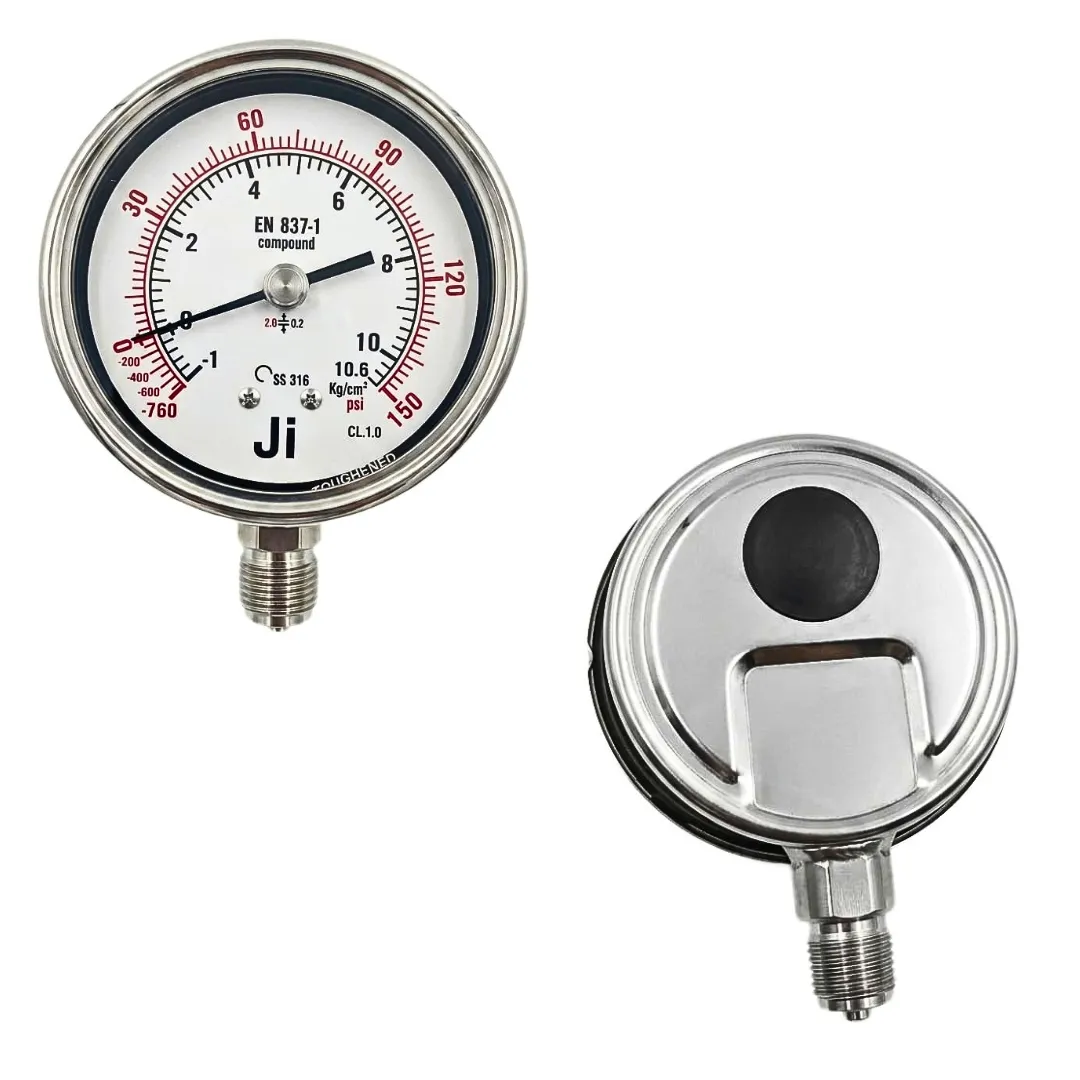
Pressure Gauge vs Compound Gauge
Pressure measurement is one of the most fundamental aspects of industrial process control. Whether in oil & gas, chemical plants, pharmaceuticals, HVAC systems, or manufacturing units, accurate pressure monitoring ensures safe and efficient operations.
Among the most commonly used instruments are pressure gauges and compound gauges. While they may appear similar in design and operation, their functionality and applications differ significantly.
Many industries mistakenly use standard pressure gauges where compound gauges are required, leading to inaccurate readings or even equipment damage. Understanding the difference between these two instruments is essential for selecting the right gauge for your application.
This comprehensive blog provides an in-depth comparison of pressure gauges and compound gauges, including working principles, construction, applications, advantages, limitations, and selection guidelines.
Table of Contents
What is a Pressure Gauge?
A pressure gauge is an instrument used to measure the pressure of a liquid or gas relative to atmospheric pressure. It indicates how much force the fluid exerts on a surface and displays the value on a calibrated dial.
Pressure gauges are widely used in industrial systems to monitor pressure levels and ensure safe operation of equipment such as boilers, pipelines, compressors, and tanks.
Working Principle of Pressure Gauge
Most industrial pressure gauges operate using the Bourdon tube principle.
Key Working Concept
A curved metallic tube (Bourdon tube) deforms when pressure is applied. This deformation is transferred through a mechanical linkage to a pointer, which moves across a dial to indicate pressure.
Key Characteristics
- Measures pressure above atmospheric pressure only
- Displays readings in positive values
- Pointer moves clockwise when pressure increases
This simple yet effective mechanism makes pressure gauges reliable and widely used across industries.
What is a Compound Gauge?
A compound gauge is a specialized pressure measuring instrument that can measure both positive pressure (above atmospheric) and vacuum (below atmospheric pressure).
Unlike standard pressure gauges, compound gauges have a dual-scale dial that includes both positive and negative pressure values.
Working Principle of Compound Gauge
Compound gauges also typically use a Bourdon tube or diaphragm as the sensing element.
Key Working Concept
- When pressure is applied → needle moves clockwise (positive range)
- When vacuum is created → needle moves counterclockwise (negative range)
Key Characteristics
- Measures both pressure and vacuum
- Dual-scale dial (negative + positive values)
- Zero point at atmospheric pressure
This dual functionality makes compound gauges highly versatile for systems where pressure fluctuates.
Key Difference Between Pressure Gauge and Compound Gauge
1. Measurement Capability
Pressure Gauge
Measures only positive pressure above atmospheric pressure. It cannot measure vacuum conditions and may get damaged if exposed to negative pressure.
Compound Gauge
Measures both positive pressure and vacuum (negative pressure) in a single instrument.
Conclusion
Compound gauges offer broader measurement capability.
2. Scale and Dial Design
Pressure Gauge
- Single scale
- Displays only positive values (e.g., 0 to 10 bar)
- Simple and easy to read
Compound Gauge
- Dual scale
- Displays negative values (vacuum) and positive pressure
- Example: -1 bar to +10 bar
Conclusion
Compound gauges have more complex but versatile dial designs.
3. Application Range
Pressure Gauge
Used in systems where pressure is always positive.
Typical applications include:
- Air compressors
- Hydraulic systems
- Steam boilers
- Water pipelines
Compound Gauge
Used in systems where both vacuum and pressure occur.
Typical applications include:
- HVAC systems
- Refrigeration systems
- Autoclaves
- Vacuum pumps
Conclusion
Compound gauges are suitable for fluctuating pressure systems.
4. Functionality
Pressure Gauge
Provides accurate measurement for positive pressure only.
Compound Gauge
Combines the function of both a pressure gauge + vacuum gauge in one device.
Conclusion
Compound gauges are more versatile.
5. Accuracy
Pressure Gauge
Offers higher accuracy in its specific range because the entire dial is dedicated to positive pressure.
Compound Gauge
May have slightly lower resolution due to combined scales (vacuum + pressure).
Conclusion
Pressure gauges are more precise for single-range applications.
6. Cost
Pressure Gauge
- Lower cost
- Simple construction
Compound Gauge
- Slightly higher cost
- More complex design
Conclusion
Pressure gauges are more economical for basic use.
7. Risk of Damage
Pressure Gauge
If exposed to vacuum, it may get damaged because it is not designed for negative pressure.
Compound Gauge
Designed to handle both pressure and vacuum safely.
Conclusion
Compound gauges are safer for fluctuating systems.
8. Industrial Usage
Pressure Gauge
Used in:
- Oil & gas pipelines
- Chemical processing
- Power plants
- Manufacturing industries
Compound Gauge
Used in:
- Pharmaceutical autoclaves
- Refrigeration systems
- Vacuum drying systems
- Air conditioning units
Conclusion
Application determines the right choice.
Detailed Comparison Table
| Feature | Pressure Gauge | Compound Gauge |
|---|---|---|
| Measurement | Positive pressure only | Positive + Vacuum |
| Scale | Single scale | Dual scale |
| Dial Range | 0 to max pressure | Negative to positive |
| Accuracy | Higher (single range) | Slightly lower |
| Cost | Lower | Higher |
| Application | Stable pressure systems | Fluctuating systems |
| Risk | Damaged by vacuum | Safe for both conditions |
Advantages of Pressure Gauge
- Simple design and operation
- High accuracy in positive pressure range
- Cost-effective solution
- Widely available and easy to maintain
- Suitable for most industrial applications
Limitations of Pressure Gauge
- Cannot measure vacuum
- Risk of damage in negative pressure conditions
- Limited application flexibility
Advantages of Compound Gauge
- Measures both pressure and vacuum
- Reduces need for multiple instruments
- Saves space and installation cost
- Ideal for dynamic systems
Limitations of Compound Gauge
- Slightly lower resolution
- More complex dial reading
- Higher initial cost
When to Use Pressure Gauge
Use a pressure gauge when:
- Pressure is always above atmospheric
- No vacuum conditions exist
- High accuracy is required
- Budget is limited
Examples include:
- Hydraulic systems
- Compressed air systems
- Water pipelines
When to Use Compound Gauge
Use a compound gauge when:
- System experiences both pressure and vacuum
- Pressure fluctuates frequently
- Space is limited
- Multi-function measurement is required
Examples include:
- HVAC systems
- Refrigeration systems
- Pharmaceutical autoclaves
- Vacuum pumps
Industrial Use Case Comparison
- Oil & Gas Industry
Pressure gauges are commonly used because systems operate under high positive pressure.
- Pharmaceutical Industry
Compound gauges are used in autoclaves where both vacuum and pressure cycles occur.
- HVAC Industry
Compound gauges are essential for monitoring refrigerant pressure and vacuum.
- Chemical Industry
Both gauges are used depending on process requirements.
Common Mistakes in Gauge Selection
- Using pressure gauge in vacuum applications
- Ignoring dual pressure conditions
- Selecting based only on cost
- Not considering safety requirements
These mistakes can lead to inaccurate readings and equipment failure.
Future Trends in Pressure Measurement
- Digital pressure and compound gauges
- IoT-enabled smart gauges
- Wireless monitoring systems
- High-accuracy sensors with remote diagnostics
Final Verdict
Choose Pressure Gauge if:
- Your system operates only under positive pressure
- You need high accuracy
- Cost is a concern
Choose Compound Gauge if:
- Your system experiences both vacuum and pressure
- You need versatility
- You want to reduce multiple instruments
Conclusion
Understanding the difference between pressure gauges and compound gauges is essential for selecting the right instrument for industrial applications. While pressure gauges are ideal for measuring positive pressure with high accuracy, compound gauges provide the flexibility to measure both vacuum and pressure in a single device.
Selecting the correct gauge not only ensures accurate measurement but also improves safety, efficiency, and equipment lifespan. By considering process requirements, pressure conditions, and operational needs, industries can make informed decisions and optimize their pressure measurement systems.
Japsin Instrumentation – Since 1974