


Description
HTC DFT-821 Laser Distance & Coating Thickness Meter — Precision, Portability, and Power in One Instrument
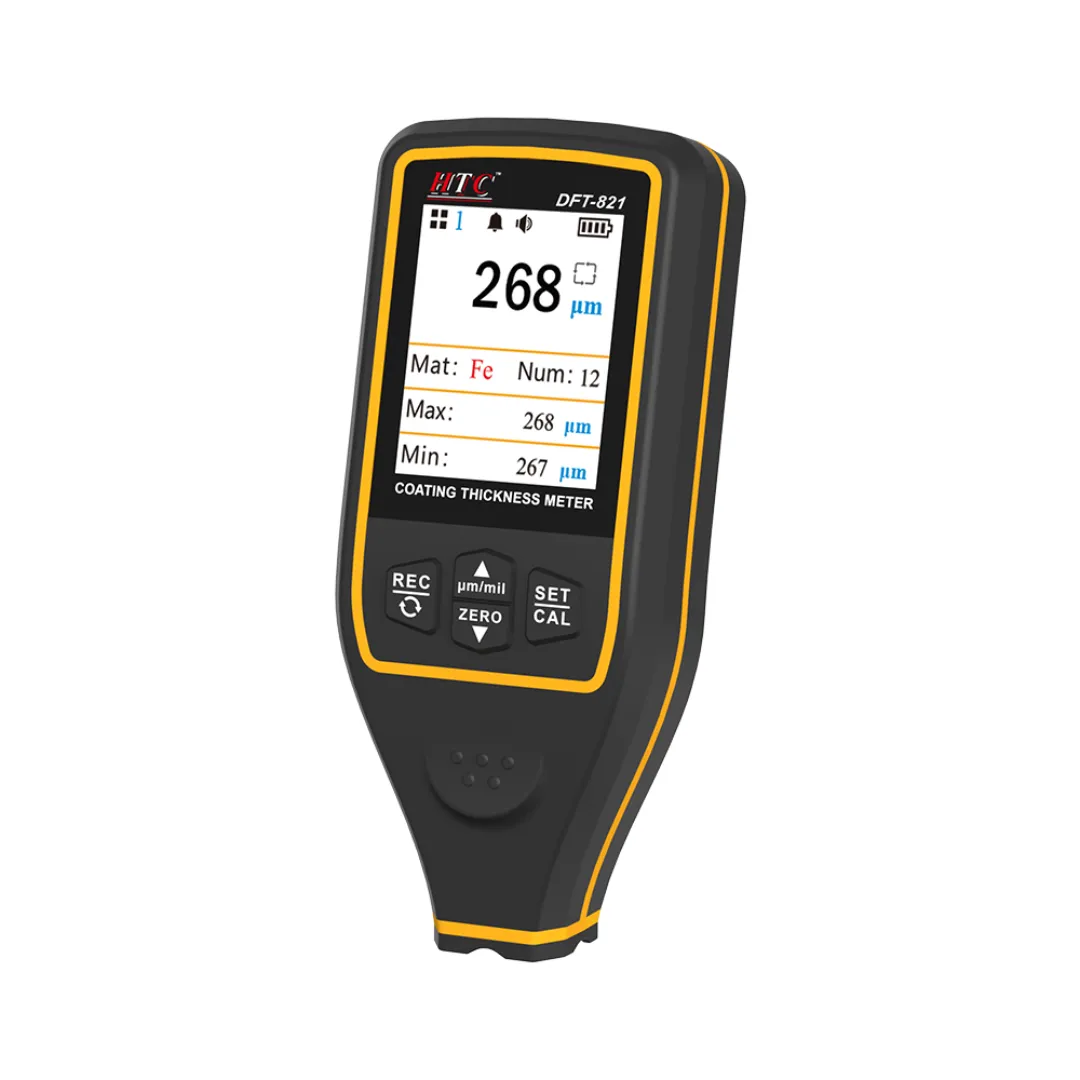
The HTC DFT-821 is a versatile measuring instrument that combines laser-assisted distance/location detection with accurate coating thickness measurement. Designed for professionals in quality control, paint & coatings, metal fabrication, inspection, and engineering, this tool makes it easy to read the thickness of coatings, monitor substrate material, store measurement groups, export data, and use in various environmental conditions. With its color screen, voice broadcast, rotatable display, and robust battery, the DFT-821 offers a modern, efficient user experience.
Key Features & Functional Capabilities
High-Resolution Coating Thickness Measurement on Magnetic & Non-Magnetic Materials
-
Wide Measuring Range: The device can measure coating thickness from 0 to 1700 µm (micrometers or “m” in the context – though µm is implied). This applies to both magnetic and non-magnetic base materials.
-
Resolution: At lower thicknesses (0-99.9 µm), the resolution is 0.1 µm, giving very fine granularity; at higher ranges (100-1700 µm), the resolution steps to 1 µm, giving practical readings across thicker coatings.
-
Indication/Error Accuracy: For measurements up to 500 µm, the error is ±(2 µm + 2% of H), where “H” is the measured thickness; for thicknesses between 500-1700 µm, the accuracy is ±(2.5% of H), accounting for higher material/measurement variability.
Minimum Substrate / Curve / Area Requirements
-
Minimum Measuring Area: Both magnetic and non-magnetic substrates must have at least a 25×25 mm flat area to make valid thickness readings.
-
Minimum Curvature: On a convex surface, the minimum curvature radius should be 5 mm; on concave surfaces, minimum radius is 30 mm, due to the probe design and sensor geometry.
-
Minimum Substrate Thickness: For magnetic materials, the substrate thickness must be at least 0.2 mm; for non-magnetic materials, 0.05 mm substrate is acceptable. This ensures the meter can properly distinguish the base metal from coating and avoid readings that may be skewed by very thin substrate.
Smart Screen & Display
-
2-Inch Color Screen: The display is color, which improves readability, enables visual differentiation of material type, thickness, warnings, etc.
-
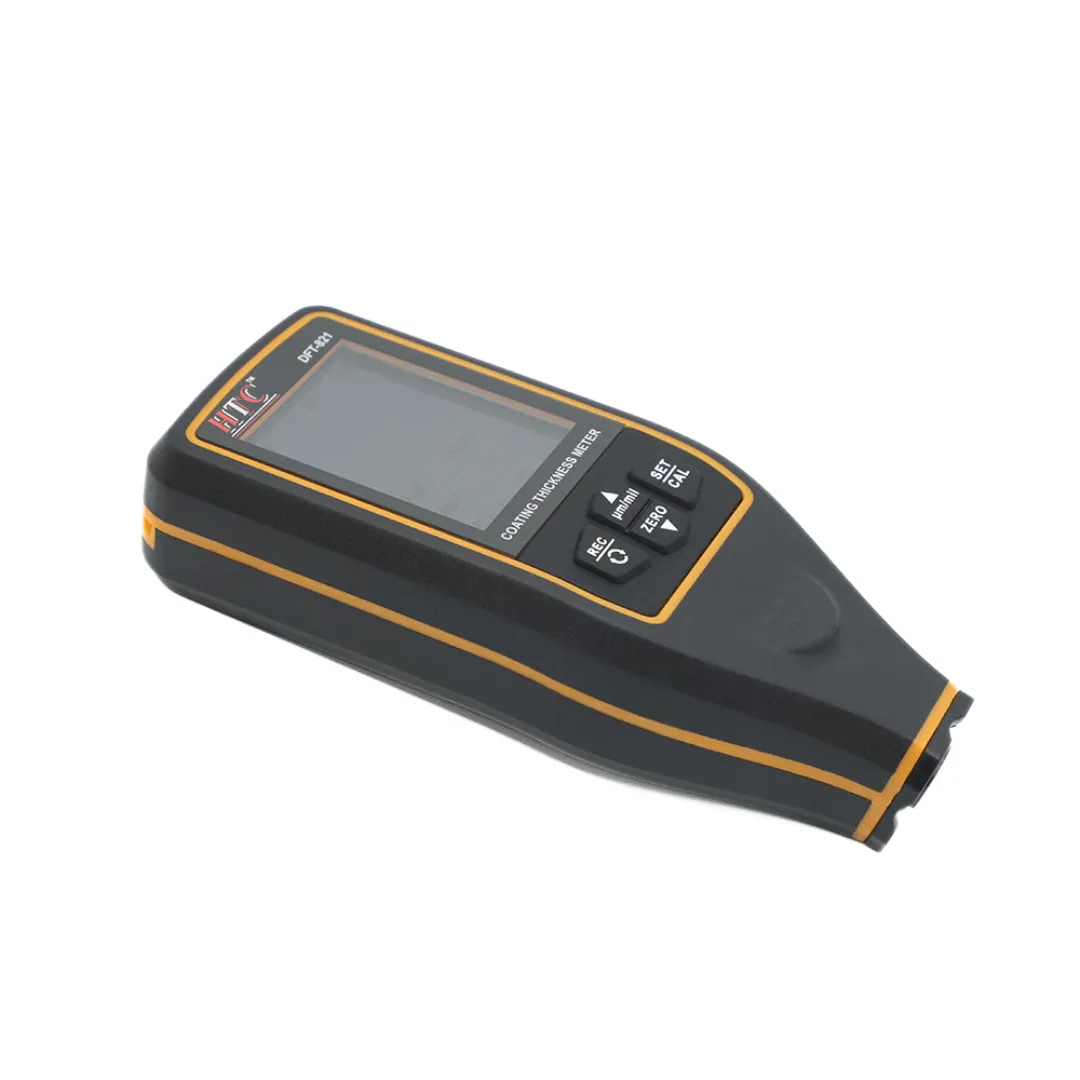
Rotatable Screen: The screen rotates in four directions, allowing the user to orient the read-out comfortably depending on how the device is held—important when working in tight spaces, on walls, ceilings, or other awkward angles.
Memory, Data Handling & Base Metal Calibration
-
Data Grouping: The DFT-821 supports 8 separate groups, each holding 32 sets of data. This lets users classify measurement runs: for example, by job, part, material, or location.
-
Calibrated Data Grouping: Each of these 8 groups can be associated with a calibrated base metal type. That means the meter “knows” what base metal material the coating is applied on—magnetic or non-magnetic—and displays corresponding material information so the user immediately knows what substrate was selected.
-
On-Screen Material & Coating Thickness: The display shows directly the thickness of the cover (coating) and the type of base metal—all in the same reading. This eliminates having to toggle modes or mentally track what substrate is in use.
Power, Connectivity & Voice Features
-
Built-in Lithium Battery: The meter is powered by a 3.7 V, 850 mAh lithium battery, providing reliable runtime without having to juggle disposable batteries.
-
USB Port for Data Export: There is a USB port that allows connecting to a PC to export stored measurement data—useful in generating reports, comparing readings, performing QC documentation.
-
Voice Broadcast Function: The meter can verbally announce readings. This is especially helpful when the user is unable to look directly at the screen—e.g., when both hands are occupied, or in low visibility, or mounting the device in odd positions.
Environmental & Physical Specs
-
Operating Temperature / Humidity: Designed to operate between 0 °C to 50 °C, with humidity between 10% to 80% RH.
-
Storage Conditions: When not in use, safe storage temperatures are –10 °C to +60 °C, humidity 10% to 70% RH, which covers most workshop, warehouse, and vehicle service environments.
-
Physical Dimensions: 120 × 52 × 26 mm—compact enough to fit in a pocket or tool belt, yet large enough to be handled and read comfortably.
Benefits & Why It’s a Strong Choice
Here are the advantages and real-world value that the DFT-821 delivers:
-
Dual Substrate Compatibility
Many coating thickness meters require separate models or probes for magnetic vs non-magnetic materials; DFT-821 handles both, saving cost and simplifying operation. -
High Accuracy & Resolution, Especially at Lower Thicknesses
The fine 0.1 µm resolution up to ~100 µm is excellent for thin coatings where detail matters (automotive primer, powder coating, anodizing etc.). For thicker coatings, the 1 µm step and accurate error margins allow reliable oversight. -
Memory & Data Management for Professional Workflows
Being able to store multiple (8) groups with 32 readings each, correlated with base metal calibration, plus data export, supports audit trails, quality control reports, frequent material checks, or multi-batch production tracking. -
User Friendly Display & Voice Capability
The rotatable color screen and voice broadcast improve usability. If the meter is used overhead, under a hood, or in tight spaces (e.g. inside engine bays, under vehicles, on large structures), you can orient the screen or rely on voice so you don’t have to constantly shift position to see. -
Portability & Battery
Lithium battery with decent capacity and USB data export make this tool suited for field jobs, remote sites, or mobile inspection. No dependency on AC outlets. The compact size further enhances portability. -
Calibrated Data Grouping & Substrate Awareness
The ability to group data and pre-set base metals avoids errors of measuring coatings on wrong substrate assumptions. For example, magnetic metals vs non-magnetic differ in sensor behavior; being able to label them accurately in reading reduces mistakes. -
Robust for Typical Environments
The operating temperature and humidity ranges reflect common shop floor or field work settings. The storage spec offers safety in downtime or transport.
Use Cases & Practical Applications
Here are potential scenarios & roles where DFT-821 is especially helpful:
-
Automotive Paint Shops & Body Repair
Checking primer & paint thickness over steel (magnetic) or aluminium (non-magnetic panels), confirming repaint jobs are within spec, comparing coatings in damage / repair areas. -
Quality Control in Coating / Manufacturing Plants
Where batches are coated, final coating thickness must be monitored; base metal calibration ensures drift is minimized; memory grouping helps compare parts, shifts, material lots. -
Metal Fabrication & Anodizing / Powder Coating
Checking thickness of protective coatings—powder, powder coat, galvanization, anodizing—on different substrates; ensuring minimal substrate damage in the process. -
Fleet Inspections & Heavy Equipment
Vehicles, trailers, machinery often use multiple materials; checking coating for corrosion prevention, spraying uniformity; field inspections benefit from voice broadcast and portable form factor. -
Maintenance & Corrosion Monitoring
In infrastructure, bridges, guard rails, pipelines—coating thickness matters to durability. DFT-821 helps monitor, record, and report before coatings degrade too far. -
Architectural Restoration / Historic Buildings
Paint layers over different materials—wood, plaster, metal—thickness matters; removal or repainting decisions often based on layer thickness; being gentle on the substrate is crucial. -
Training & Educational Use
For technical schools teaching coatings, materials science, quality control, the memory/storing/export and substrate differentiation help students understand material/coating interplay.
Operational & Best Practice Advice
To maximize utility and ensure accurate measurements:
-
Surface Preparation: Clean the coating surface; remove debris, dust, grease—because surface contaminants can bias thickness readings.
-
Zero Calibration: For non-magnetic coatings, ensure proper zeroing on bare substrate if possible; for magnetic materials likewise. Using base‐metal calibration in groups helps.
-
Ensure Minimum Area & Curvature Conditions: Use areas at least 25×25 mm; avoid trying to measure on small curved edges or very convex/concave surfaces because readings there may be unstable or unreliable.
-
Stable Massage & Contact Pressure: Press the probe gently, avoid tilting; consistent contact helps repeatability.
-
Consistent Substrate Type: If doing many measurements across items of different substrate, keep them grouped so base-metal calibration, group awareness, and substrate tracking works accurately.
-
Battery Monitoring & Charging: Keep the lithium battery charged, avoid deep discharges; the battery spec ensures solid use, but like all lithium cells it ages if left empty, so periodic charging is beneficial.
-
Data Export & Archiving: Use the USB export feature to download measurement data, keep backups. Use the grouping to label jobs, materials, parts for historical reference.
-
Environmental Factors: Humidity, temperature extremes can affect readings slightly; while device is rated for 0-50 °C, readings in very hot or cold conditions may drift or become less stable.
Specification Recap
Here’s a consolidated summary of technical specs and system details for DFT-821:
| Specification | Detail |
|---|---|
| Measuring Range | 0 – 1700 µm coating thickness (both magnetic & non-magnetic materials) |
| Resolution | 0.1 µm for 0-99.9 µm; 1 µm for 100-1700 µm |
| Indication Error | ±(2 µm + 2% of measured thickness) for 0-500 µm; ±(2.5% of thickness) for 500-1700 µm |
| Minimum Measuring Area | 25 × 25 mm |
| Minimum Curvature | Convex: 5 mm radius; Concave: 30 mm radius |
| Minimum Substrate Thickness | Magnetic: 0.2 mm; Non-magnetic: 0.05 mm |
| Screen Display | 2-inch color screen, rotatable in four directions |
| Memory / Data Groups | 8 groups × 32 sets per group; groups linked to base-metal calibration |
| Voice Broadcast | Yes |
| USB Data Export | Yes |
| Battery | 3.7 V, 850 mAh lithium rechargeable |
| Operating Conditions | 0 °C to +50 °C, 10–80% RH |
| Storage Conditions | –10 °C to +60 °C, 10–70% RH |
| Physical Dimensions | 120 mm × 52 mm × 26 mm |
Final Thoughts
The HTC DFT-821 is a mature, feature-rich instrument aimed squarely at professionals who need reliable, accurate coating thickness measurements across different material substrates—magnetic and non-magnetic—combined with excellent usability, data handling, and portability. With its high resolution in low thickness ranges, generous max range (up to 1700 µm), substrate calibration, memory & export, rotatable color screen, voice broadcast, and robust environmental tolerances, the device bridges many gaps often found in simpler testers.
If your work includes frequent coating evaluation (auto body, metal finishing, protective coatings), managing or comparing multiple materials, or doing inspections (site, shop, field), the DFT-821 provides confidence, ease, and repeatability.

Reviews
There are no reviews yet.