


Description
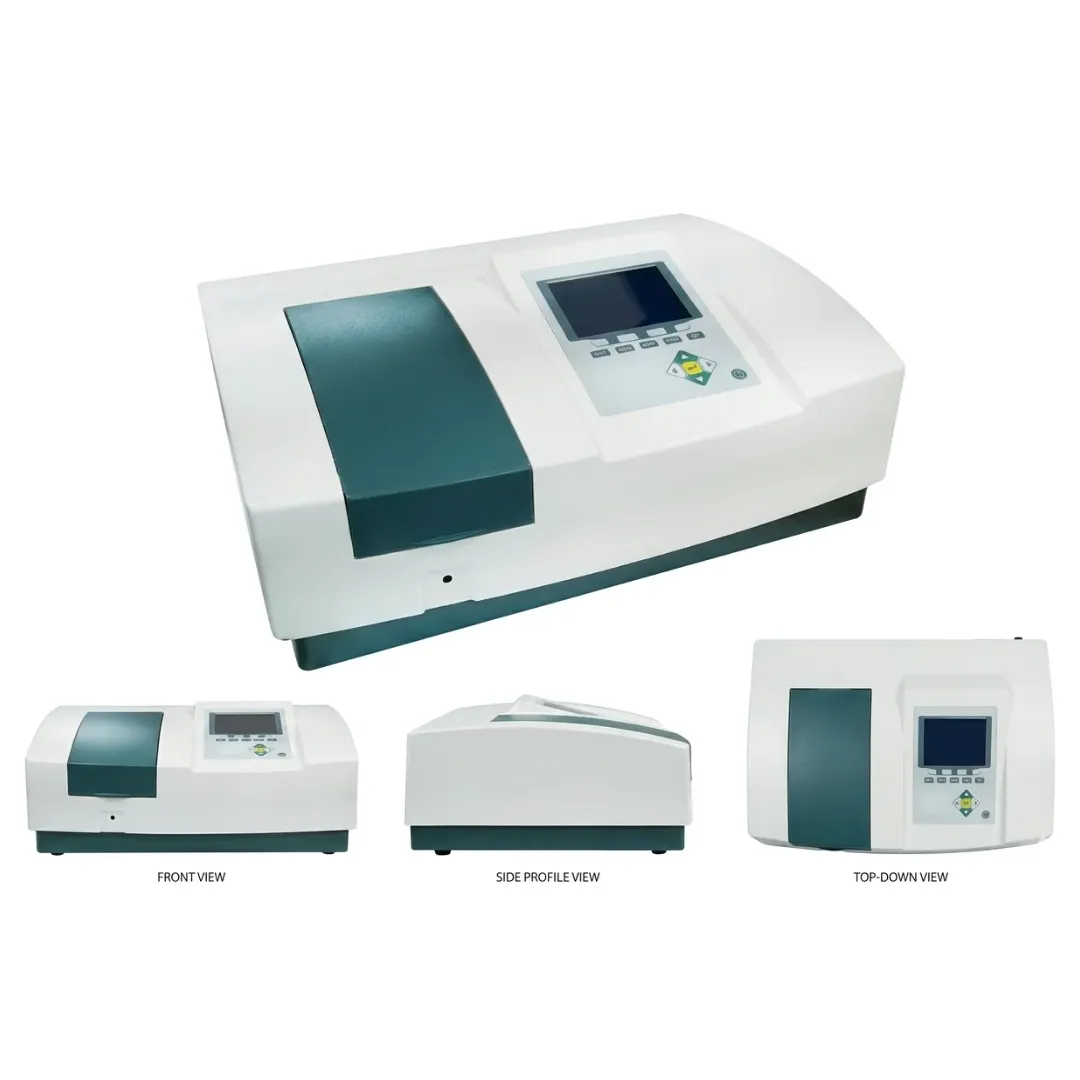
Double Beam Microprocessor UV-VIS Spectrophotometer – Advanced Laboratory Analysis
The JIPL Double Beam Microprocessor UV-VIS Spectrophotometer is an advanced analytical instrument designed for accurate and reliable measurement of absorbance, transmittance, concentration and spectral characteristics of liquid samples. Operating across a broad wavelength range of 190 nm to 1100 nm, this instrument supports ultraviolet and visible spectroscopic analysis for laboratory research, industrial testing and quality control applications.
Equipped with a microprocessor-controlled double-beam optical system, the instrument is designed to provide stable measurements and support baseline correction during sample analysis. Its combination of deuterium and tungsten light sources, high-resolution optical arrangement, LCD display and multiple measurement modes makes it suitable for laboratories requiring versatile spectrophotometric testing.
1. Double-Beam Optical System for Stable Measurements
The JIPL Double Beam UV-VIS Spectrophotometer uses a double-beam optical configuration to measure sample and reference signals through separate optical paths. This arrangement helps compensate for fluctuations in light-source intensity and supports improved measurement stability during analysis.
By comparing the sample signal with the reference signal, the instrument helps reduce the influence of background variations and supports more consistent absorbance and transmittance measurements. This is particularly useful for routine laboratory analysis, research work and quality control procedures where measurement repeatability is important.
2. Wide Wavelength Range: 190–1100 nm
The instrument offers a broad wavelength operating range of 190 nm to 1100 nm, covering ultraviolet and visible regions and extending into the near-infrared boundary of the specified range.
This wide operating range enables laboratories to analyse different chemical compounds and prepared solutions according to their absorption characteristics. The instrument has a specified wavelength accuracy of 0.1 nm and spectral bandwidth of 1 nm, supporting wavelength selection for analytical procedures.
3. Deuterium and Tungsten Light Sources
The JIPL Double Beam Spectrophotometer uses two light sources to support measurements across its operating wavelength range:
- Deuterium Lamp: Provides ultraviolet light for analysis of samples absorbing in the UV region.
- Tungsten Lamp: Provides visible and longer-wavelength illumination for measurements in the visible region.
The combination of these lamps allows the instrument to support UV-VIS analysis without requiring separate instruments for different spectral regions. The appropriate lamp is selected according to the wavelength used for the measurement.
4. Multiple Measurement Modes
The instrument supports five important measurement modes for different analytical requirements:
Absorbance Mode: Measures the amount of light absorbed by a sample at a selected wavelength. It is widely used in quantitative chemical analysis and laboratory testing.
Transmittance Mode: Measures the percentage of incident light transmitted through a sample. This mode is useful for evaluating the optical transparency of solutions.
Concentration Mode: Supports concentration determination using appropriate standards and calibration procedures. It helps users perform routine quantitative analysis.
Spectrum Mode: Supports spectral measurement across selected wavelengths, allowing users to examine the absorption characteristics of samples.
Kinetics Mode: Supports monitoring of changes in optical measurements over time, which is useful for studying reaction progress and time-dependent analytical processes.
5. Microprocessor-Based Operation
The microprocessor-based control system supports instrument operation and management of measurement functions. It helps coordinate wavelength selection, optical measurement and display of analytical readings.
The instrument is designed for convenient laboratory operation, allowing users to select the required measurement mode and perform testing according to the relevant analytical procedure. Its LCD display provides a direct interface for viewing measurement information.
6. 1 nm Spectral Bandwidth
The instrument features a specified spectral bandwidth of 1 nm. Spectral bandwidth determines the range of wavelengths passed through the monochromator for measurement.
A narrow bandwidth can be useful when analysing samples with closely spaced absorption features or when greater wavelength selectivity is required. The 1 nm specification makes the instrument suitable for a range of laboratory spectrophotometric applications.
7. Eight-Cell Holder and Sample Compatibility
The JIPL Double Beam UV-VIS Spectrophotometer is listed with an eight-cell holder, along with standard and multi-cuvette sample holder compatibility. This arrangement supports sample handling for laboratory testing and provides flexibility when working with multiple prepared samples.
The appropriate cuvette material and path length should be selected according to the wavelength, sample properties and analytical method. Quartz cells are generally preferred for ultraviolet measurements, while suitable glass or other compatible cells may be used for visible-region applications.
8. RS-232 Communication Interface
The instrument is equipped with an RS-232 interface for communication with compatible external equipment. This interface can support data communication and integration with suitable laboratory computer systems or accessories.
The availability of an external communication interface is useful in laboratory environments where measurement information needs to be transferred or incorporated into record-management workflows. Specific software, data storage and reporting functions should be confirmed for the supplied configuration.
9. Applications Across Multiple Industries
The JIPL Double Beam Microprocessor UV-VIS Spectrophotometer is suitable for a wide range of laboratory applications, including:
- Pharmaceutical Laboratories: Supporting analysis of suitable pharmaceutical compounds and prepared solutions.
- Chemical Industries: Measuring absorbance, transmittance and concentration of chemical samples.
- Food and Beverage Laboratories: Performing spectrophotometric testing using appropriate analytical methods.
- Clinical Laboratories: Supporting optical analysis of compatible prepared samples.
- Environmental Laboratories: Analysing water and environmental samples through validated spectrophotometric procedures.
- Academic Institutions: Supporting practical experiments and spectroscopy education.
- Research Laboratories: Conducting quantitative and qualitative UV-VIS analysis.
- Quality Control Departments: Performing routine sample evaluation and comparative measurements.
10. A Versatile Instrument for Professional Laboratory Testing
The JIPL Double Beam Microprocessor UV-VIS Spectrophotometer combines a wide wavelength range, double-beam optical system, dual light sources and multiple measurement modes in one benchtop instrument. Its 1 nm spectral bandwidth, LCD display, eight-cell holder and RS-232 interface make it a practical option for laboratories requiring versatile UV-VIS measurement capabilities.
For pharmaceutical manufacturers, chemical laboratories, research institutions, food testing facilities and industrial quality control departments, this instrument provides a comprehensive solution for routine spectrophotometric analysis and sample evaluation.
Key Features
- Microprocessor-based instrument control
- Double-beam optical measurement system
- Wide 190–1100 nm wavelength range
- Deuterium and tungsten dual light sources
- 1 nm spectral bandwidth
- Five measurement modes
- Eight-cell holder arrangement
- LCD display
- RS-232 communication interface
- Suitable for pharmaceutical, chemical, food, clinical and environmental laboratories
Japsin Instrumentation – Since 1974


Reviews
There are no reviews yet.