


Description
Plastic Threaded Rotameter for Water – 3000 to 12000 LPH
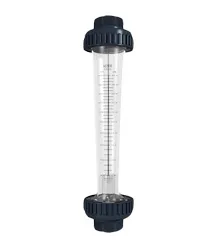
The Plastic Threaded Rotameter for Water, Range 3000 to 12000 LPH is a practical, economical, and reliable variable-area flow measurement instrument designed for continuous visual monitoring of water flow in industrial, commercial, process, utility, and water-treatment applications. With a high flow measurement range of 3000 to 12000 Litres Per Hour (LPH), this rotameter is suitable for applications where a simple, direct, and easily visible indication of higher water-flow rates is required.
Designed specifically for water with a specific gravity of 1, this plastic threaded rotameter combines a transparent polycarbonate body, durable SS 316L float, and ABS end material to provide a lightweight and practical construction for compatible water-flow applications. The transparent measuring section enables operators to observe the float position directly while the system is running.
The instrument features 2″ BSP (M) threaded connections at both the top and bottom, allowing inline installation into compatible piping systems. The standard flow direction is bottom inlet and top outlet, ensuring the float operates correctly within the measuring section.
The rotameter uses the established variable-area principle. As water enters from the bottom and flows upward, the float rises or falls according to changes in flow rate. Once the flow stabilizes, the float reaches a corresponding position on the graduated scale, allowing the operator to determine the approximate water flow.
With a specified accuracy of 2% of full scale, maximum operating temperature of 60°C, and maximum operating pressure of 5 kg/cm², this model provides a convenient solution for general-purpose higher-flow water monitoring within its specified operating conditions.
Variable-Area Flow Measurement Principle
The Plastic Threaded Rotameter works on the variable-area flow measurement principle, which is widely used for simple and continuous flow indication.
Water enters through the lower connection and moves upward through the measuring section. The upward force of the water causes the SS 316L float to rise. As the water flow increases, the float moves upward; when the flow decreases, the float moves downward.
At a stable flow condition, the float settles at a position corresponding to the flow rate. The operator can observe the float through the transparent polycarbonate body and compare its position with the graduated scale.
The mechanical operating principle provides several advantages:
- Direct visual flow indication
- Continuous local monitoring
- No external power required for basic indication
- Simple operation
- Easy visual inspection
- Low-maintenance construction
- Economical flow measurement
- Quick identification of flow changes
This makes the rotameter suitable for industrial systems where straightforward local flow indication is preferred.
3000 to 12000 LPH Flow Range
This model is designed for a water-flow range of:
3000 to 12000 LPH
The higher capacity makes it suitable for larger water-flow circuits and process applications.
The wide range allows operators to monitor flow conditions across various industrial and utility systems.
Typical applications may include:
- Water treatment plants
- RO and water purification systems
- Industrial cooling-water systems
- Filtration plants
- Process-water circulation
- Utility-water lines
- Industrial machinery
- Water circulation systems
- Process equipment
- Washing and cleaning systems
- Industrial water distribution
The instrument should be selected according to the actual operating flow and used within its specified pressure and temperature limitations.
Transparent Polycarbonate Body
The measuring body is made from polycarbonate, providing a transparent section for direct observation of the float.
This construction allows the operator to visually monitor the flow without relying on an electronic display.
The transparent body can help operators:
- Confirm that water is flowing
- Observe changes in flow
- Monitor float movement
- Identify unstable flow
- Detect unexpected flow reduction
- Perform routine visual inspections
Polycarbonate also contributes to the lightweight and economical design of the rotameter.
The instrument must be operated within the specified maximum operating temperature and pressure.
SS 316L Float
The rotameter uses an SS 316L float as the primary moving measurement element.
The float responds to changes in water flow and moves vertically inside the measuring section. Its position corresponds to the flow rate indicated on the scale.
SS 316L is widely used for industrial instrumentation components because of its corrosion-resistant characteristics and suitability for compatible water and process applications.
The durable float construction supports reliable operation under the specified conditions.
2″ BSP (M) Connections
The rotameter is supplied with:
2″ BSP (M) threaded connections at top and bottom
These connections allow the instrument to be installed inline with compatible piping systems.
The recommended flow arrangement is:
Bottom Inlet → Measuring Section → Top Outlet
Correct orientation is important because the float is designed to operate vertically using the relationship between fluid flow and gravity.
Before installation, verify that the existing piping and fittings are compatible with the 2″ BSP male connections.
Designed for Water – Specific Gravity 1
The instrument is calibrated for:
Water – Specific Gravity 1
The supplied flow scale is intended for water having the specified density characteristics.
If a different liquid is used, differences in density and viscosity can affect the relationship between float position and flow rate. Therefore, the rotameter should be used for the intended water application unless suitable correction factors or application-specific calibration are available.
Maximum Operating Temperature – 60°C
The specified maximum operating temperature is:
60°C
This allows the rotameter to be used for many normal-temperature and moderately warm water applications.
The actual process temperature should be checked before installation, and the specified maximum temperature should not be exceeded during operation.
Maximum Operating Pressure – 5 kg/cm²
The specified maximum operating pressure is:
5 kg/cm²
The rotameter should be installed in systems where operating pressure remains within this specified limit.
Pressure fluctuations and sudden pressure surges should also be considered when designing or modifying the piping system.
Proper support and alignment of the connected piping can help minimize mechanical stress on the instrument.
2% Full-Scale Accuracy
The specified accuracy is:
2% of Full Scale
This accuracy is suitable for a wide range of general-purpose industrial water-flow monitoring applications.
The instrument is particularly useful where the objective is to monitor flow continuously, verify adequate water circulation, and identify significant changes in flow.
For highly precise or certified flow measurement applications, the specified accuracy should be evaluated against the specific requirements of the process.
Tamper-Proof Scale Sticker
The rotameter is provided with a tamper-proof scale sticker for flow indication.
The scale graduation is:
LPH / LPM
The operator can observe the float position and compare it against the corresponding graduation on the scale.
For best reading consistency, flow should be allowed to stabilize before taking a measurement.
The scale provides a simple and convenient local reference for routine process monitoring.
Dimensions
The approximate dimensions of the instrument are:
400 mm Height × 120 mm Width
The measuring body is designed to accommodate the specified 3000–12000 LPH flow range.
Adequate clearance should be provided around the instrument during installation to allow the operator to view the scale and float easily and perform routine inspection.
Applications
1. Water Treatment
The rotameter can be used to monitor water flow through compatible treatment, filtration, and circulation equipment.
2. RO and Water Purification
It can provide direct visual flow indication in suitable reverse-osmosis and water-purification systems.
3. Cooling-Water Systems
The instrument can be used to monitor compatible industrial cooling-water circuits where continuous water circulation is required.
4. Filtration Systems
It can provide a convenient indication of water flow through suitable filtration equipment.
5. Process-Water Systems
The 3000–12000 LPH range makes this model suitable for higher-flow process-water applications.
6. Industrial Utility Lines
The rotameter can be used for monitoring water circulation in compatible industrial utility systems.
7. Industrial Machinery
It can be applied to compatible water-based cooling, cleaning, circulation, and process applications.
Benefits of This Plastic Threaded Rotameter
1. Simple Operation
The instrument does not require complicated programming or electronic configuration for basic visual flow indication. Operators can simply observe the float and read the scale.
2. Continuous Visual Monitoring
The transparent body enables continuous observation of the float position while the process is running.
3. Economical Flow Measurement
The mechanical construction offers an economical alternative for applications where advanced electronic flow measurement is not necessary.
4. Easy Installation
The 2″ BSP (M) connections at the top and bottom allow convenient installation into compatible inline piping arrangements.
5. Low Maintenance
The straightforward mechanical construction minimizes the complexity associated with routine inspection and maintenance.
6. Higher Flow Capacity
The 3000–12000 LPH range makes this model suitable for higher water-flow applications compared with smaller-capacity rotameters.
Installation Guidelines
For proper operation, the rotameter should be installed vertically, with the inlet at the bottom and outlet at the top.
Before commissioning, check the following:
- Confirm compatibility of the piping with the 2″ BSP (M) connections.
- Install the instrument vertically.
- Maintain the specified bottom-to-top flow direction.
- Keep operating flow within 3000–12000 LPH.
- Keep operating pressure within 5 kg/cm² maximum.
- Keep water temperature within the 60°C maximum limit.
- Ensure piping is properly aligned and supported.
- Ensure the float can move freely.
- Avoid excessive vibration and sudden pressure surges.
- Allow the flow to stabilize before reading the scale.
Maintenance
Routine maintenance is relatively simple because of the instrument’s mechanical construction. Periodically inspect the polycarbonate body, SS 316L float, scale, threaded connections, and overall physical condition.
If deposits, dirt, or other contaminants restrict float movement, the instrument should first be safely isolated from the process before cleaning or servicing.
Regular inspection can help identify abnormal float movement, deposits, physical damage, or connection problems and can contribute to reliable operation.
Conclusion
The Plastic Threaded Rotameter for Water – 3000 to 12000 LPH is a practical and economical solution for continuous local monitoring of higher water-flow rates. Its variable-area measurement principle, transparent polycarbonate body, SS 316L float, ABS end construction, tamper-proof LPH/LPM scale, and 2″ BSP (M) threaded connections provide a simple and effective method for visual flow indication.
With a 3000–12000 LPH flow range, 2% full-scale accuracy, maximum operating temperature of 60°C, and maximum operating pressure of 5 kg/cm², this model is suitable for compatible water-treatment, RO, cooling-water, filtration, process, and industrial utility applications.
For applications requiring a simple, visible, economical, and low-maintenance water-flow monitoring instrument, this Plastic Threaded Rotameter offers a convenient solution for industrial process and utility systems.
Japsin Instrumentation – Since 1974


Ayaansh Patel –
Great value!
Devanshvi Kapoor –
Exceptional fit, great investment!
Saanvi Patel –
Nice Product