


Description
Microprocessor Flame Photometer Meter
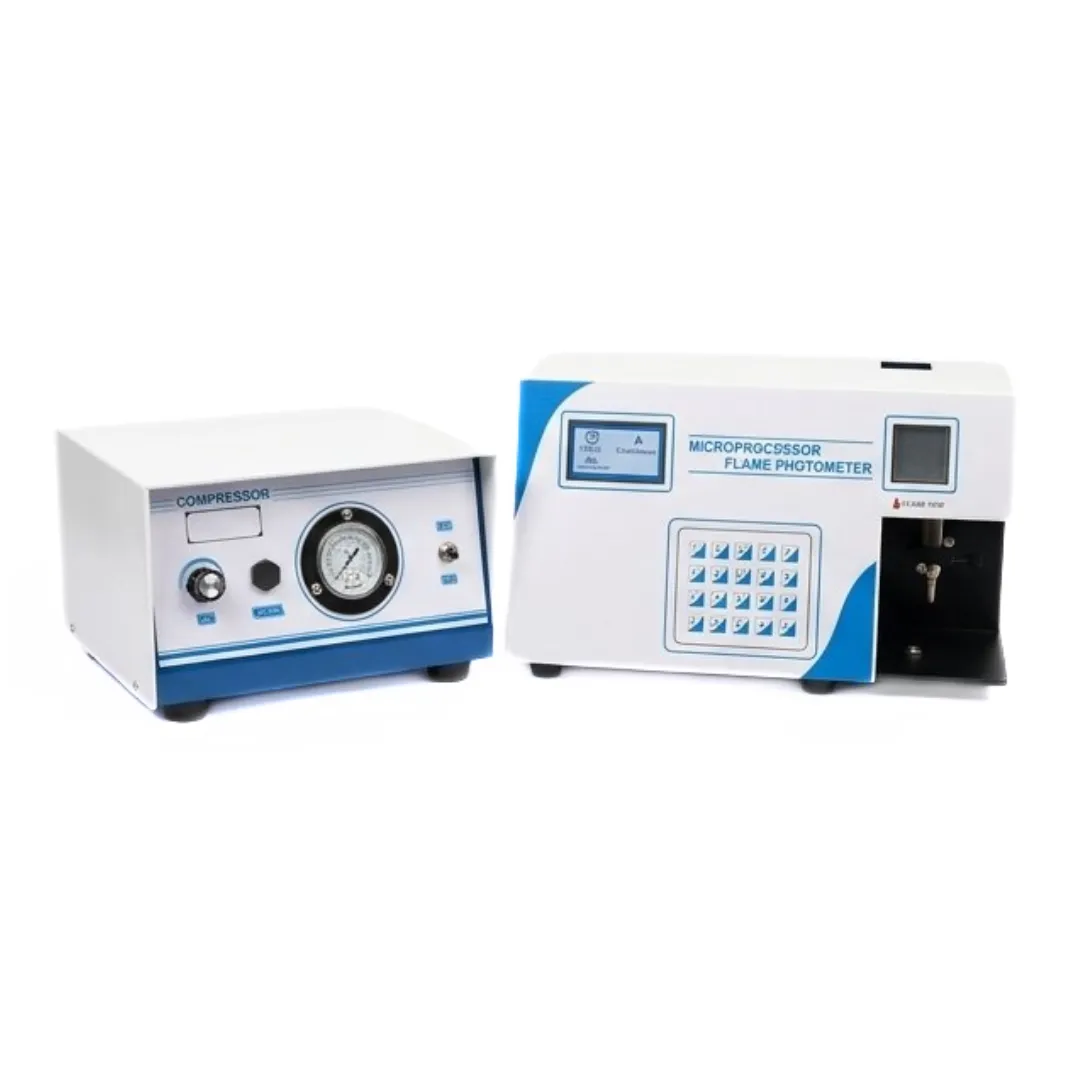
The JIPL Microprocessor Flame Photometer Meter is an advanced laboratory analytical instrument designed for the quantitative measurement of sodium (Na), potassium (K), calcium (Ca), lithium (Li) and barium (Ba) in liquid samples. It uses microcontroller-based technology and flame photometry to determine elemental concentrations with digital measurement, programmable calibration and data storage facilities.
The instrument is suitable for medical laboratories, clinical testing facilities, soil testing laboratories, agricultural research centres, pharmaceutical laboratories, educational institutions and industrial quality-control departments. Its ability to measure multiple elements, store calibration curves and display concentration results in ppm and meq makes it useful for routine analytical testing.
The instrument features a microprocessor-based operating system, soft-touch membrane keys, a backlit 20 × 4-character alphanumeric LCD and a printer interface. One of its key features is the ability to measure four elements in a single aspiration, helping simplify sample analysis and reduce repeated sample introduction.
Sky Technology India
Multi-Element Measurement Capability
The JIPL Microprocessor Flame Photometer is designed to measure five elements: sodium, potassium, calcium, lithium and barium. The available measurement configuration includes general, serum and urine applications, with different concentration ranges and sample dilution requirements.
For general applications, the instrument provides measurement ranges of 0–100 ppm for sodium, potassium, calcium and lithium, and 50–1000 ppm for barium.
For clinical applications, dedicated serum and urine measurement ranges are specified. These ranges are designed around particular sample dilution ratios, making the instrument suitable for laboratories performing relevant clinical and biochemical analysis.
The instrument supports measurement of four elements in a single aspiration. This feature can help laboratories improve testing efficiency by reducing the need for separate aspiration procedures for every selected element.
Microprocessor-Based Operation
The instrument uses modern microcontroller technology to process measurement signals and manage calibration, data storage and operating functions. Soft-touch membrane keys provide convenient access to instrument settings and measurement operations.
A backlit 20 × 4-character alphanumeric LCD displays measurement information, making it easier for laboratory personnel to view readings and operate the instrument.
The software includes an in-built averaging facility to support measurement processing. This helps users obtain averaged results according to the instrument’s programmed operation rather than relying only on individual readings.
Advanced Calibration and Curve Fitting
Calibration is an important part of flame photometry because it establishes the relationship between the measured optical response and the concentration of the element in the sample.
The JIPL Microprocessor Flame Photometer supports calibration using a maximum of 25 standards, with up to five standards per element. It also provides multiple calibration curve storage, allowing users to save different calibration setups for their analytical requirements.
The instrument uses curve-fitting techniques, including least-square and quadratic methods, for data processing. These facilities help generate calibration curves based on the selected standards and support concentration determination across the configured measurement range.
The ability to save multiple calibration curves can be useful for laboratories that regularly test different sample types or work with different analytical methods.
Direct Results in ppm and meq
The instrument displays concentration results in ppm and meq, providing flexibility for different laboratory reporting requirements. Its stated resolution is 0.1 ppm/meq.
This is particularly useful in laboratories where concentration results need to be interpreted, recorded or compared using different reporting units. Users should select the appropriate element, calibration curve and measurement configuration before testing samples.
Flame Photometry Working Principle
Flame photometry is based on the characteristic light emitted by certain elements when they are introduced into a flame. During measurement, the liquid sample is aspirated through an atomizer, where it is converted into a fine mist.
The sample mist mixes with air and fuel in the mixing chamber before entering the flame. The heat excites atoms of the elements present in the sample. As these atoms return to a lower energy state, they emit light at characteristic wavelengths.
Optical filters isolate the required emission signals, while the silicon photodiode detector measures the light intensity. The instrument’s microprocessor processes the detector signal and calculates the corresponding elemental concentration using the selected calibration curve.
Optical Filters and Silicon Photodiode Detector
The instrument uses a silicon photodiode detector to measure the optical signals generated during flame analysis. Element-specific filters help isolate the required emission signals for individual measurements.
Sodium and potassium filters are supplied as standard accessories. Calcium and lithium filters are available as optional accessories at additional cost. Users requiring calcium or lithium analysis should confirm the necessary filter configuration before purchasing the instrument.
The manufacturer also specifies measurement capability for barium. However, the published filter list does not clearly state the barium filter supply arrangement, so this should be confirmed with the supplier.
Automatic Ignition and Flame Safety Features
The instrument operates with LPG and dry, oil-free air. It includes an automatic ignition system to simplify flame starting and an adjustable gas-control arrangement for regulating the operating conditions.
For safer operation, the instrument provides automatic flame-failure detection and automatic gas cut-off. These features are designed to detect flame failure and stop the gas supply automatically, helping reduce the risk associated with continued gas flow when the flame is extinguished.
The atomizer is an axial-flow type, and the mixing chamber supports the preparation of the sample mist before it enters the flame. A suitable external air supply and regulated LPG connection are required for operation.
Data Storage and Printer Connectivity
The JIPL Microprocessor Flame Photometer provides setup storage and sample data storage facilities. These functions help laboratories retain instrument settings and measurement records for routine testing and documentation.
A Centronics parallel interface supports compatible dot-matrix, HP LaserJet and inkjet printers (non-Windows printer support, as specified by the manufacturer). An RS-232C interface is also available for computer connectivity. PC software is optional and should be confirmed separately.
These connectivity facilities can be useful for laboratories that need to maintain printed reports, transfer measurement information or organise analytical records.
General, Serum and Urine Testing Applications
The instrument provides separate measurement configurations for general, serum and urine applications. This makes it relevant to laboratories that perform elemental analysis on different types of prepared liquid samples.
-
Medical and clinical laboratories: Measurement of sodium, potassium, calcium and lithium in suitable prepared samples.
-
Serum analysis: Testing using the specified serum ranges and dilution ratios.
-
Urine analysis: Measurement using the specified urine ranges and sample dilution requirements.
-
Soil testing laboratories: Analysis of selected elements in appropriately prepared soil extracts.
-
Agricultural laboratories: Supporting elemental analysis of soil and plant extracts.
-
Research institutions: Routine measurement of selected alkali and alkaline earth metals.
-
Educational laboratories: Demonstrating flame photometry and analytical chemistry principles.
-
Industrial laboratories: Elemental concentration testing in compatible liquid samples.
The appropriate sample preparation method, dilution ratio and calibration procedure should always be followed for the selected application.
Compressor Unit and Laboratory Installation
The manufacturer specifies an oil-free mini compressor with a pressure regulator as the air-supply arrangement. LPG is used as the combustion gas and is controlled through a precision regulator.
The compressor unit has its own power requirement of 230V ±10% AC, 50Hz. Its approximate dimensions are 290 × 255 × 210 mm, and its approximate weight is 8 kg. The main instrument weighs approximately 7.5 kg and measures 285 × 255 × 210 mm.
Before installation, laboratories should ensure that the instrument has an appropriate power supply, regulated gas connection, suitable ventilation and adequate working space. Operators should follow the manufacturer’s instructions for gas connections, ignition, flame operation, shutdown and maintenance.
A Complete Solution for Multi-Element Laboratory Analysis
The JIPL Microprocessor Flame Photometer combines multi-element measurement, programmable calibration, curve storage, data processing and digital reporting in one analytical instrument. Its ability to measure sodium, potassium, calcium, lithium and barium, together with dedicated general, serum and urine configurations, makes it suitable for a range of laboratory applications.
For medical, agricultural, soil testing and research laboratories, the instrument offers a practical solution for routine flame photometric analysis. Its automatic ignition, flame-failure detection, gas cut-off and printer/computer interfaces further support convenient laboratory operation.
Compressor Unit Specifications
| Parameter | Specification |
|---|---|
| Air Supply | Oil-free mini compressor with pressure regulator |
| Combustion Gas | LPG with precision regulator |
| Power Supply | 230V ±10% AC, 50Hz |
| Dimensions | 290 × 255 × 210 mm (L × B × H), approx. |
| Weight | 8 kg, approx. |
Japsin Instrumentation – Since 1974


Reviews
There are no reviews yet.